AI Tools for Parents That Give You Your Time Back
Last week we sorted the 10:47 p.m. list into four piles: automate it, share it, hand it to a trusted person, and keep it. A lot of you wrote back with the same question: okay, but which tools actually belong in the first pile?
Fair question. It is also a risky one, because "AI for parents" can quickly turn into a shopping list for a bigger to-do list. We don't need a new project. We need fewer of them.
So this week is a short, honest tour of AI tools for parents, judged by one test: does it take a task off your plate, or does it put one on? If it adds to your day, skip it.
The Rule Behind the List: Automate the Pile, Don't Grow It
The tech industry loves to sell optimization: a better system, a smarter routine, a more efficient you. But the mental load was never a skills problem. Mothers are not disorganized. We are carrying an enormous amount of invisible planning that no one assigned us, and a tool that asks us to become experts at it misses the point.
Parenting advice has a long history of telling mothers to try harder: wake up earlier, batch your meals, keep a family binder. Every piece of it adds a task to the person already carrying the most. The useful question isn't "how do I fit this in?" It's "what does this let me stop doing?"
One honest caveat from last week deserves repeating. Feeding a tool is work. An assistant only knows what you tell it, and if you are the only person in the house who talks to it, you haven't shared the load, you've changed its format. So whatever you try, put your partner on the shared calendar from day one and agree on who owns what.
AI Tools for Parents That Take Tasks Off Your Plate
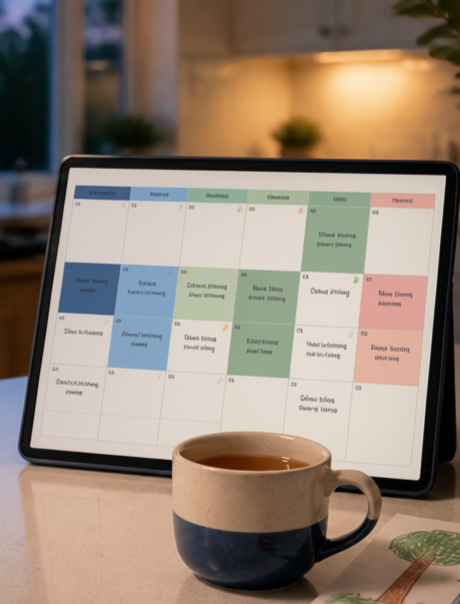
For the family calendar: Skylight Calendar 2 and Cozi
The calendar is where a surprising amount of mental load lives, because someone has to read every flyer, email and text and copy the dates in. That copying is exactly what these tools aim to remove.
Skylight unveiled its Calendar 2 at CES in January 2026. It's a countertop family organizer that merges calendars from sources like Google Calendar, iCal, Microsoft and TeamSnap, and, according to coverage of the launch, uses AI to read a photographed paper flyer or email and add the dates for you. It also handles meal planning, grocery lists and chore tracking. The same coverage says another AI feature can look at a photo of your refrigerator and suggest recipes, with recipe-based shopping lists that connect to Instacart. (Dataconomy, Jan. 8, 2026)
A shared screen in the kitchen also means the schedule is visible to everyone, so the kids can see Thursday's soccer practice without asking you. Fewer "when is..." questions means fewer interruptions for you, and it puts the schedule in front of your partner without a reminder from you.
Cozi, which we mentioned last week, is the software-only option. Its free plan covers a shared family calendar, lists and recipes. Gold, at $39 a year, removes ads and adds extras like calendar search and change notifications. Its Max plan, listed at $79 a year, adds AI Event Import, which reads invitations in your inbox and puts them on the calendar, plus an AI Recipe Creator and AI Meal Planner. (Pricing from Cozi's plan comparison page, which carried a June 2026 update date; check the page for current pricing.)
The point of both is the same: the flyer from the backpack becomes an event without you typing it. One small task gone, and small tasks are what the day is made of.
For homework: Khanmigo
Last week's piles were about the household. This one is about your kids' evenings. Khanmigo is an AI tutor from the nonprofit Khan Academy, and its design is the reason I like it: it's built to guide a learner toward an answer rather than hand it over. That gives your child a patient first stop for a stuck problem, so you aren't the only person at the kitchen table at 8 p.m. A parent subscription can cover up to 10 children under 18, with a monthly or annual payment. Parents and learners need to be 18 or older, U.S.-based and have a U.S. billing address. (Khanmigo)
This lines up with what parents already tell researchers. In Pew Research Center's fall 2025 survey of 1,458 U.S. teens and their parents, about six in ten parents said they were okay with their teen using AI chatbots for schoolwork, and roughly eight in ten for searching for information. Only 18% were comfortable with emotional support from a chatbot. Parents are drawing a sensible line: AI for learning and logistics, not for relationships. (Pew Research Center, Feb. 24, 2026; each figure is the share of parents surveyed who said they were okay with that use for their own teen.)
For the long tail: a general AI assistant
A general-purpose AI assistant (ChatGPT, Claude, you name it) is for the thousand small writing and thinking tasks that eat the evening: the email to the teacher, the birthday invitation, a messy week turned into a short list, five dinners from what's already in the fridge, or fractions explained in a way a nine-year-old will buy. Describe the task the way you'd describe it to a friend, and read what comes back before it goes anywhere. Keep the judgment calls, like what you say about your child, with you.
What a Lighter Week Can Look Like
It helps to picture the result, so here is what disappears rather than what you add.
The flyer in the backpack is already on the calendar. The dinner question has an answer you didn't have to invent. The email you've been avoiding is drafted, and you only have to edit it. Your child got unstuck on a math problem without you relearning long division. And when the calendar shows an evening where the kids can't come, the scramble is shorter, because you spend a few minutes booking a sitter you trust instead of an hour texting everyone you know.
That last one is the pattern. Automate what is information. Give what is people a calmer, earlier start. You don't have to do more. You get to do less of the part that was draining you.
A quick word on the second pile, because no app can do it for you. If the calendar now shows everything, the next step is a short conversation, not another tool: which categories belong to your partner, by name, with a date. A shared screen makes the load visible. A person still has to agree to pick it up. Technology can make that conversation easier to start, but it can't have it for you, and it shouldn't have to.
Permission to Do Less
Here is what I am not asking of you.
I'm not asking you to try five apps this weekend. If one tool fixes the place your week leaks the most, that's enough. If none of them fit your life, that's fine too.
I'm not asking you to become the family's IT department. If a tool takes more than a few minutes to start giving value, it hasn't earned a spot.
I'm not asking you to optimize. A calmer Tuesday is the goal. A color-coded one is not.
There is one thing worth a quick look, once: what a tool does with your children's information. Check the privacy policy for what's collected and whether you can delete it. And because AI is sometimes wrong, give anything with consequences, like a date, a dosage or a pickup time, a second glance. That's the whole checklist.
The Pile No Tool Can Take
Here is where I want to be direct, because it's the reason I built Call Emmy.
Every tool above is excellent at information: dates, lists, recipes, explanations. None of them can be the trusted adult who walks in the door when you have a keynote, a client dinner or a conference to attend. That's the third pile from last week. AI can find you a sitter's profile. It cannot vet the person, meet your child's eyes, or sit on the floor and build a fort.
That gap matters for women's careers in particular. When the logistics are automated but the care isn't, mothers still end up declining the panel, skipping the dinner, leaving the conference early. Those quiet subtractions add up to lost visibility and lost earning power, and almost no one counts them.
So my suggestion is a division of labor, and the goal is relief, not another to-do list. Let AI absorb the paperwork. Keep real, vetted humans in charge of the care. The goal was never a more efficient mom. It was a mom who doesn't have to carry it all.
If you're navigating something similar, Call Emmy was built for moments like this.