The Holiday Calendar Nobody Plans For
The Holiday Calendar Nobody Plans For
Pull up the family calendar for December and look at it honestly. The office holiday party. The client dinner your manager asked you to attend. Two school concerts in the same week, one at 2 p.m. on a Tuesday. A friend's fortieth. The neighborhood cookie exchange. A gala you bought tickets for in August. And somewhere in the middle of all of it, two weeks of winter break when school closes and work does not.
Each of these looks manageable on its own. Together, they form the most crowded stretch of the year, and almost every item on the list carries the same hidden requirement: someone has to watch the kids. Holiday babysitting is not a nice-to-have in December. For working mothers, it is the difference between showing up for the season and spending it on the sidelines of your own life.
December Arrives All at Once
Last week I wrote about the holiday parties and year-end conferences where careers quietly move forward, and why so many mothers end up declining those invitations. This week I want to talk about what happens on the other side of the RSVP.
Most of us do not lack the desire to attend. We lack a plan. The invitations arrive one at a time over several weeks, so we handle them one at a time. A text to a grandparent here. A favor from a neighbor there. A maybe to the host while we figure it out. By mid-December, the favors are used up, the grandparents are traveling, the teenage sitter down the street is booked by three other families, and the answer to the next invitation becomes no by default.
The problem is not any single event. It is that care gets planned event by event, while the season itself arrives all at once.
The Plan Usually Has One Name on It
There is a reason this falls apart the way it does. In most households, the holiday plan has one name on it. Someone tracks the concert dates, buys the teacher gifts, remembers the ugly sweater day, books the travel, plans the meals, and figures out who is watching the kids while all of it happens. That someone is usually Mom.
This is what people mean by the mental load. It is not only the work itself. It is the job of noticing the work, organizing it, and carrying it in your head until it is done. Childcare logistics sit at the very top of that load, because nothing else on the calendar happens until it is solved. You cannot say yes to the client dinner until you know who is home with the kids. You cannot accept the friend's party until you have someone you trust.
And during the holidays, the load does not just grow. It compounds.
What the Research Says
This is not just a feeling. In December 2025, Bright Horizons released a survey of working parents on holiday stress. Sixty-eight percent said juggling work and childcare is a top source of their holiday stress. Forty-seven percent said they need more childcare support just to finish their holiday to-do lists. Thirty-four percent said they need extra childcare options, such as backup care or holiday camps, during school breaks. And 51 percent said they feel increased guilt balancing family time with work and seasonal responsibilities.
Here is how those numbers were produced. The research firm Opinium surveyed 500 employed U.S. parents of young children on behalf of Bright Horizons. The survey did not break results out by gender. In my experience, though, the person searching for backup care in December is usually the same person carrying the rest of the holiday plan.
Look closely at what the numbers say. The strain is not the holidays themselves. It is the collision of a normal work schedule with a season that adds events, closes schools, and assumes someone at home is free to absorb the difference. Nearly half of these parents are not asking for less to do. They are asking for help getting it done, and the help they named is childcare.
The Cost of Saying No
When care is not planned, mothers absorb the gap. We leave the party early. We skip the client dinner and tell ourselves it was optional. We spend a winter break day answering email from the kitchen table while refereeing an argument over the iPad. We give up the one date night we promised ourselves in November.
None of these feels like a big loss in the moment. That is why they add up. By January, many of us are more exhausted than we were in October, further behind at work, and wondering where the season went.
This is not a personal failing. It is a planning problem dropped on the person with the least spare capacity. And planning problems can be solved.
How to Plan Holiday Babysitting Before December Fills Up
The single most useful thing you can do is plan care for the whole season at once, now, before the calendar locks up. Here is the approach I recommend to every parent who asks me.
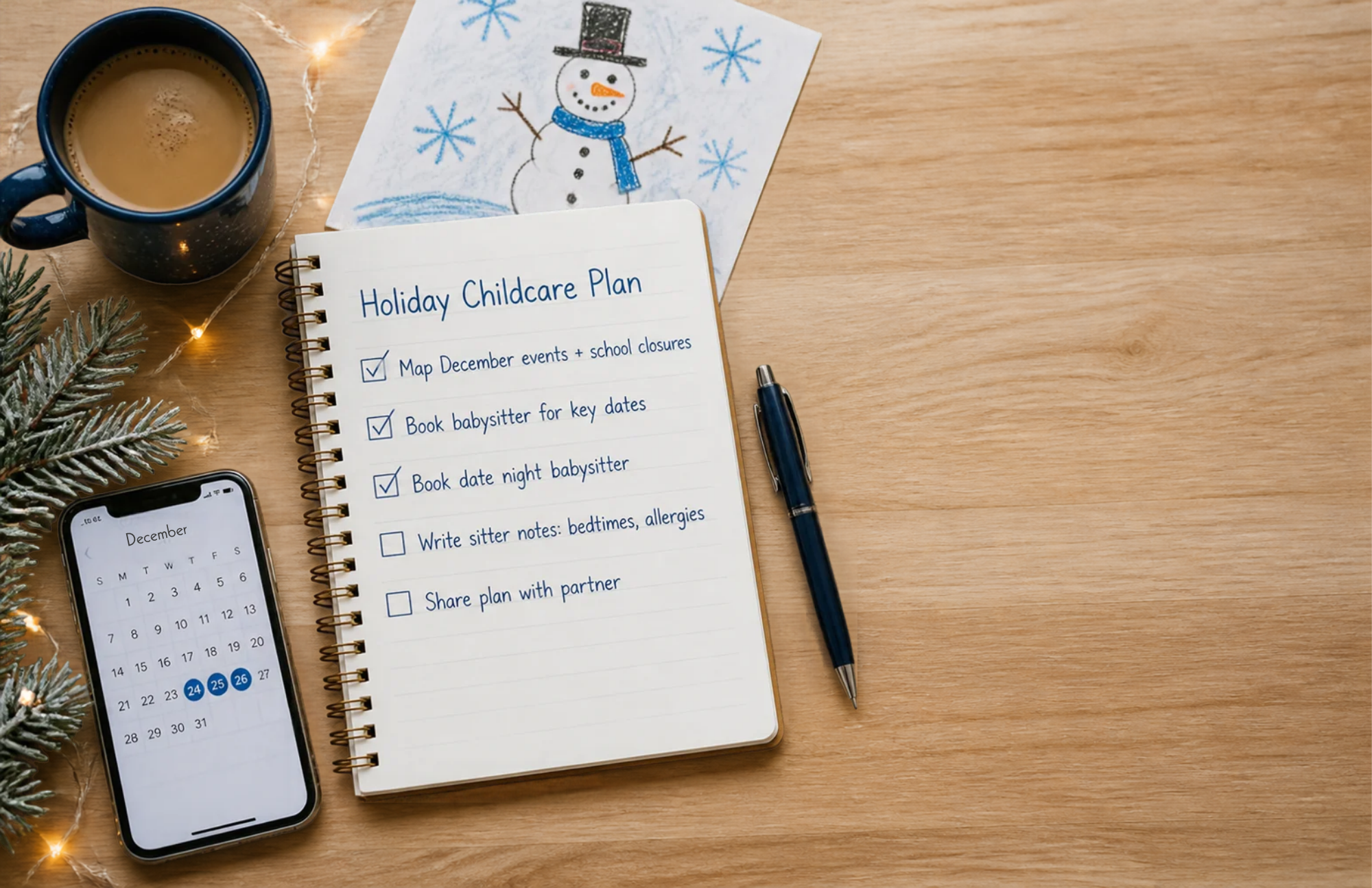
Map the season in one sitting. Take thirty minutes this week and list every event between Thanksgiving and New Year's you might attend, plus every day school or daycare is closed. Include the maybes.
Sort by type of care. Evening events like parties and dinners need a sitter at home, usually for a few hours after bedtime routines start. Daytime school concerts and closures need longer daytime coverage. Winter break childcare often needs full days, sometimes several in a row. Each type calls for a different plan, and lumping them together is how things fall through.
Book the anchor dates first. Identify the three or four events that matter most, whether for your career, your relationships, or your sanity, and secure care for those before anything else. December is peak season for sitters. The families who book early get their first choice. The families who book late take what is left.
Protect at least one night that is just for you. Put a date night or an evening with friends on the calendar and book a date night babysitter for it the same way you would for a work event. If it is not booked, it will be the first thing to go when the season gets busy.
Write the handoff once. Create one simple document with bedtimes, allergies, emergency contacts, screen time rules, and the Wi-Fi password. Share it with every caregiver this season. It saves you from repeating the same instructions five times and lowers the mental load of each booking.
Share the plan. If you have a partner, put the plan where both of you can see it, and split the booking and handoff tasks. A plan with two names on it is far more durable than a plan carried in one person's head.
If you do not have a trusted sitter yet, this is the moment to find one, not the week of the party. Call Emmy was built for exactly this situation: parents can book a vetted sitter for date nights, school closures, and last-minute needs without spending an evening making phone calls.
What to Look for in a Holiday Sitter
Speed matters in December, but safety matters more. Whoever you hire, ask the questions you would ask any time of year.
Has the sitter been background checked, and by whom? Have their skills been assessed, or are you relying on a profile alone? Do they have experience with your children's ages, especially if you have an infant or a child with specific needs? Can they handle a full winter break day, not just an evening after bedtime? Will they follow your rules on screens, food, and bedtimes, even when the kids push back because it is the holidays?
A good sitter should leave you more relaxed when you walk out the door, not less. If you find yourself checking your phone all night, the arrangement is not doing its job.
Permission to Plan for Yourself
I want to say something directly to the mother reading this at the end of a long day. Planning care so you can go to a party is not indulgent. Booking a sitter so you can sit through a two-hour client dinner without watching the clock is not a luxury. Getting one evening of rest during the most demanding month of the year is not selfish.
These are the moments where relationships are built, where careers move, and where you get to be a person and not only a project manager for everyone else's joy. The holidays are supposed to belong to you too.
The calendar is going to fill up whether you plan for it or not. The difference is whether it fills up with things you get to show up for. Plan the care now, book the dates that matter, and give yourself a season you actually get to enjoy.